1
Color
Make each card your own
Parallel Arcana starts in black and white so every reader, colorist, or collector can bring a personal palette to the deck.

The Acts
Think of the Major Arcana as a story told in three parts. The Fool is the traveler, and each card shows something learned along the way.
The Fool is card 0 and the traveler. The journey begins when The Fool steps into Act 1 and starts learning along the way.
Act 1 is about the outside world: learning who you are and how you fit in.
Act 2 is about the inside world: understanding feelings, fears, and intuition.
Act 3 is about the bigger picture: letting go, growing wiser, and seeing how things connect.
Artists can create their own version of a card inside the shared Act 1 frame. The frame makes the deck feel connected, while the artwork can still be completely their own.
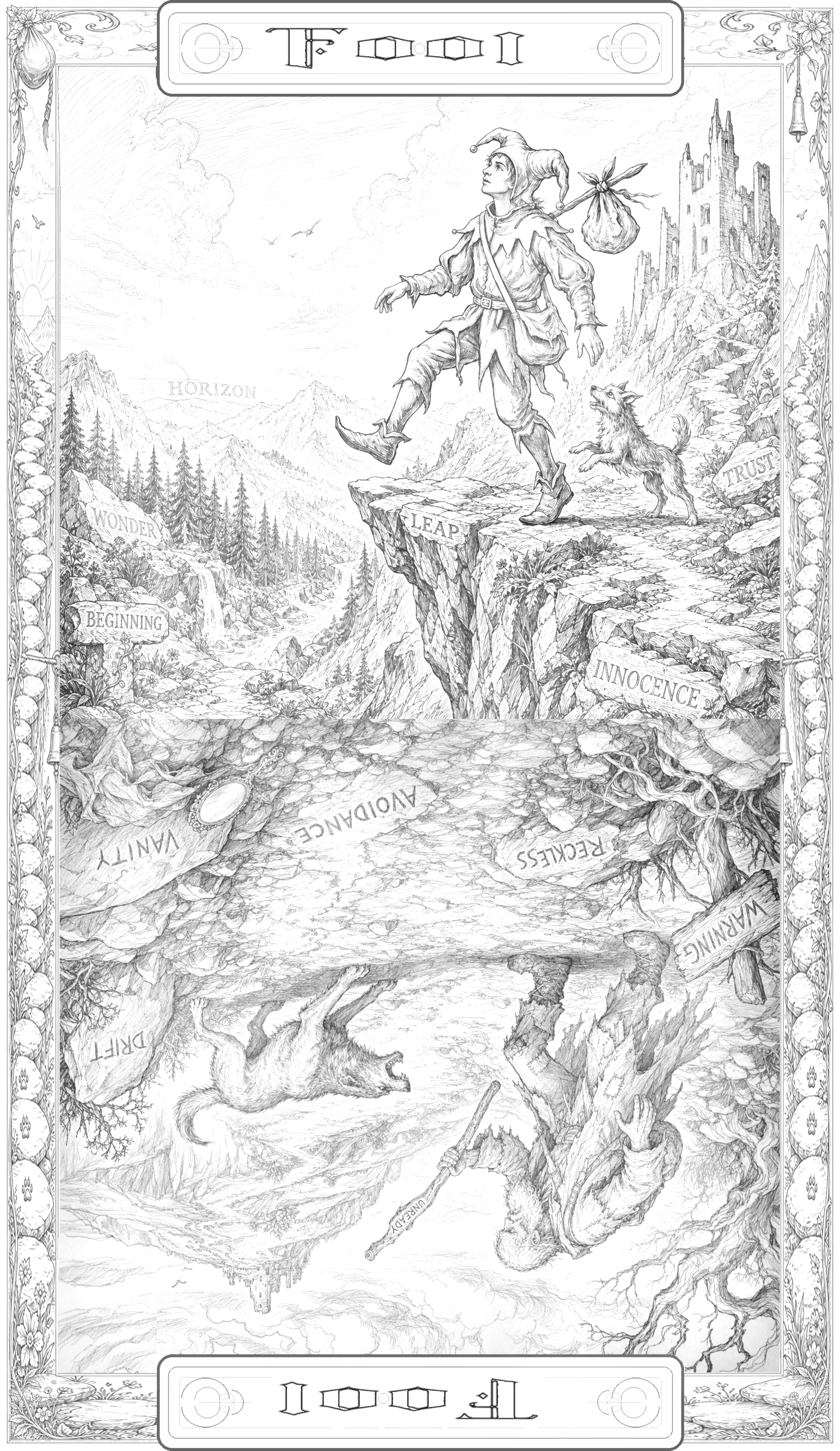
Reading the structure
The three Acts give the Major Arcana a clear path. The shared frame keeps every contribution connected while each artist still has room to interpret the card.
The Major Arcana can be read in three Acts. For this project, those Acts give the collaboration a natural sequence without turning the public site into a rulebook.
Act I is the Outer World: the cards of ego, society, identity, ambition, and the visible structures a person learns to move through.
Act II is the Inner World: the cards of soul, shadow, intuition, subconscious pattern, and the private work beneath the surface.
Act III is the Spiritual World: the cards of awakening, surrender, cosmic connection, and the larger pattern. If this Anthology succeeds, the Minor Arcana and pip cards can follow.
Each card holds both sides of its meaning: the upright story and the reversed shadow. The format keeps the deck consistent while still leaving room for strong art and final adjustments.
About the deck
Parallel Arcana is a 78-card black-and-white tarot coloring deck made for slower attention. It is not only something to read. It is something to sit with, color, compare, and return to.
The deck is also the first physical anchor for Anthologies. Support around it helps fund the larger site, where future artists can enter the room, respond to symbolic prompts, and help shape later collections.
Color
Parallel Arcana starts in black and white so every reader, colorist, or collector can bring a personal palette to the deck.
Study
The upright story and reversed shadow are woven into the artwork, so coloring becomes a slow way to notice the card.
Gather
The deck can be a private ritual, a journal companion, or a shared table for friends and family comparing what they see.
Fund
The deck helps promote and fund Anthologies, the larger site being built for future artist paths and symbolic collections.
Pipeline
This is the working map. Some steps are live now, some are being built for the portal, and contract-dependent steps become final only after testing and written rules.
Public
Visitors can read the project, learn the tarot structure, join updates, or move toward the artist path. Artists create or connect a wallet before submitting.
Process note: The public site routes people to updates, wallet help, art parameters, and the collaboration form.
Form
Artists share contact information, a concept, medium/category, optional portfolio or public link, and the exact public wallet address they control.
Process note: The form validates required fields, uses spam protection, and sends the submission to the intake tracker without exposing private webhook URLs.
Human
The team reviews the submission for concept clarity, medium fit, wallet readiness, and how the artist could help create attention around a card.
Process note: The tracker can organize status, categories, notes, and AI-assisted draft follow-ups, but humans make the actual decision.
Access
If accepted, the artist may receive Golden Fool Token access in their wallet. It identifies them inside the system and opens the next door.
Process note: A wallet-gated portal can check whether the connected wallet holds the Golden Fool Token before showing artist-only areas.
Portal
The Golden Galleria begins the portal path by recognizing Golden Fool holders and explaining current rules in plainer language than a blockchain explorer.
Process note: Wallet connection can identify the artist, show their access state, and reveal only the steps they are allowed to take.
Choice
An accepted artist chooses one available Act 1 card or artwork direction to work on. The Fool may still exist as a sketch card artists can reinterpret.
Process note: The system can record the card assignment so the portal knows who is working on what and can reduce accidental double assignment.
Work token
Golden Fool access can let the artist mint or receive a working token for that chosen card. It belongs to their wallet, but it is not the final public collectible yet.
Process note: A work slot can connect one wallet, one artist, and one card assignment while the artwork and metadata are still being prepared.
Studio
The artist downloads source material, frame guidance, and art parameters, then creates the color treatment, original design, or hybrid interpretation.
Process note: Standards can be shown clearly, but the review remains flexible because art is not a machine checklist.
Submission
The artist submits the finished artwork, title, description, artist credit, traits, concept notes, and preferred launch options such as timing, price tier, and signal strategy.
Process note: The portal can collect files, preferred launch settings, links, and acknowledgements in one place before the release is prepared.
IPFS
After review, the final metadata is uploaded to IPFS or Pinata, and the correct token ID points to that approved image and description record.
Process note: The metadata URI can be set per token ID, so one artist edition can be prepared without changing every other card in the collection. Pinning keeps the artwork and metadata available.
Final lock
When the artist and project agree that the direction is final, that specific token ID can be locked so the public release cannot quietly change later.
Process note: Locking metadata protects the released blockchain record. It does not erase the artist's authorship or broader creative ownership, which must be handled in written terms.
Signal
The artist may signal at their leisure or allow Anthologies to signal at drop time. The artist's community should be the center of the alert.
Process note: When configured, the site can show launch state, countdowns, availability, and official artist links without changing the contract by hand.
TAC
A short Tokenized Asset Creation window opens at the agreed time. The public sees the card, the artist, the rules, and the path to collect if the release is live.
Process note: The contract can enforce price, active/inactive status, per-wallet limits, supply rules, and payment routing where those rules are finalized.
Settlement
If a release sells, contract logic can route primary sale proceeds according to the written agreement. Royalties can be signaled where marketplaces support them.
Process note: Primary sale logic can split funds between the artist and project when configured before launch. Marketplace royalty behavior can vary, so it should not be treated as magic.
After
The artist may choose another work, wait, or stop. There is no pressure to keep going simply because access was granted.
Process note: The tracker and portal can preserve history so future collaborations start from what already happened instead of restarting from scratch.
Plain language
These are the project words people will see as they move from public curiosity into artist participation.
The access token that can identify accepted participants and open artist-only portal areas. It is not a guarantee of selection, resale, payment, or liquidity.
The private working area where accepted artists can see rules, choose work, submit files, and review next steps.
Tokenized Asset Creation: a scheduled release window where approved work can be created as a tokenized asset under written rules.
Node Function Token Signature: the project term for a contract-backed token signature or asset record tied to access, art, or participation.
The first sale or TAC release of a card. Any split should be handled by written terms and contract settings before the release goes live.
A working token or assignment record connected to an accepted artist and chosen card before the final public release. It is not the collector edition.
Storage used for approved token metadata and images so the released token points to a durable public record instead of a normal private file.
The on-chain token record that can keep pointing to the approved card metadata over time. The image usually lives through IPFS/Pinata, while the contract records the token path.
A final token record that can no longer be edited quietly. Locking protects collectors while written terms preserve the artist's authorship and rights.
The configured primary-sale routing between the artist and project. It should be set before release and backed by the written artist agreement.
A future resale signal that may route value back to creators where marketplaces and contracts support it. It is not universally enforced everywhere.
The public description and image data attached to a token. It should explain what the item is in plain language.
Automation
Form validation, spam protection, and server-side submission forwarding.
Submission tracking by status, medium, wallet readiness, and next action.
Wallet-gated portal reads for Golden Fool Token access.
Card assignment records for accepted artists.
Artist work-slot records that connect one accepted wallet to one card path before public release.
Per-token metadata URI setting, IPFS/Pinata pinning, and metadata locking after review.
Launch-state display such as scheduled, live, closed, or complete.
Contract enforcement for finalized TAC rules such as active status, price, supply, and one-per-wallet limits.
Primary payment routing between artist and project when the contract is configured for it.
Royalty signaling where marketplace infrastructure honors it.
Human judgment
Whether a submission is accepted.
Whether the artist's work fits the card, act, and release moment.
Final rights, payment, and launch terms.
Whether a submitted metadata record is ready to upload and lock.
Whether a finished piece is ready for public release.
Whether later batch TAC releases or special uses happen with artist permission.
When a policy should slow down instead of becoming automatic too early.
Payments
Possible payments should come after an accepted work, written terms, a configured contract, and a live release. Nobody should read the public page as a promise of sales.
The first TAC window can route sale proceeds by contract once the artist and project have agreed to the release terms.
The cleanest path is a per-token sale configuration that sends an agreed share to the artist wallet and an agreed share to the project wallet during the primary sale.
Royalties can keep artists connected to later market movement where the contract and marketplace support that behavior.
Physical or special collections can be explored later only with clear permission and a fair split for the artists involved.
Guardrails
No AI-generated collaboration submissions.
The two-sided tarot-card structure is the project standard, but strong art can still be reviewed if adaptation is needed.
Golden Fool Token access opens the working path; it does not promise resale, profit, liquidity, or a guaranteed release.
Actual contract rules belong in written terms and the Golden Fool Token portal before real value enters the system.
Artists should not send recovery phrases, private keys, passwords, or login codes to anyone.